10 October 2006

Anna Politkovskaya, not fearless at all


"Internationally admired for her fearless reporting . . ."

Anna Politkovskaya wasn't fearless. "One of the few journalists who had refused to keep her mouth shut", she acted as if giving in to fear was not an option (though her mission was self-imposed), and reported for the common good (though she could have had a comfy existence, 'reporting' the centre of power).

She also had American citizenship and has been compared to Bob Woodward, but there is a stark difference between what and how she reported and the standards she set herself, and the It's all politics. The good of the nation? What's that? embedded journalism in America today, exemplified by Woodward, the New York Times and the Washington Post, who haven't missed a beat in keeping in with the shifting power base. Too often, the 'free press' acts as if it is based in a place like Russia, or the lesser evil but still nothing like 'free' Singapore.

In liberal democracies, it is all about freedom of the press from government; in Singapore, it is about the government’s freedom from the press.- Cherian George, Freedom from the Press: Why the media are the way they are

An article in the Independent said about Politkovskaya, "At a time when the Russian media is falling over itself to fawn over Mr Putin and sustain a Soviet-style cult of personality around him, her work provides a lone dissenting voice and a voice that cannot be heard in Russia - at least outside the pages of her liberal newspaper Novaya Gazeta."

The International Press Institute maintains a 'Watch List'. The Russia Watch List Report makes fascinating reading.
Media bias remains a feature of elections in Russia. The Russian Union of Journalists (RUJ) monitored the lead up to the 2004 presidential elections held on 12 May. The results of the monitoring showed clear evidence of self-censorship and favouritism towards the incumbent president.

Politkovskaya was not unique. There are many like her who are not famous, but who face imprisonment, financial ruin, threats to themselves and their families, and death. But they still report.

International PEN reports about them, and translates books like Anna Politkovskaya's Putin's Russia.

The Committee to Protect Journalists reports about them. Read, for instance, The Enemy, about Al-Jazeera's Sami al-Haj, jailed for five years without charge or trial.

Reporters Without Borders reports about them, and about events that often curiously miss the NEWS. Take for instance, this story in their breaking news today:

The International Press Institute (IPI) is perhaps the most curious group, as the statements they issue are much more informative and hard-hitting than the stuff that is considered fit as 'news'. Read, for instance, their statement: Media Targeted During the Ongoing Middle East Crisis

They maintain a Death Watch. Today the number for 2006 is 53.

IPI includes in its "Death Watch" journalists and media staff who were deliberately targeted because of their profession - either because of their investigative reporting or simply because they were journalists. IPI also includes journalists who were caught in the crossfire while covering dangerous assignments.

There are many groups working for press freedom, such as this coalition mentioned in Sri Lankan news.

In 2005, 58 journalists were murdered, and more than 500 were arrested. Journalists' committees are forming in many nations, including that hotbed of non-sensational news, Malta, where the Malta Media reported, "The Committee will be campaigning for a Freedom of Information Act, a Whistleblower Act, an overhaul of the Press Act and libel laws, and plans to organise a national seminar on Freedom of Information this year."

It's not as if there isn't good analysis around. See, for instance,
Today, the chaos of US foreign policy goes nuclear, in ePluribus Media. It's just that other stuff makes the 'news'.

I just Google-newsed "Katie Couric" and got 3,180 stories, the top one (Bloomberg) being typical: " Katie Couric has lost almost a third of her viewers since she took over as anchor of ``The CBS Evening News'' and now trails predecessor Bob ..."

Next, "press freedom": 1,630.

05 October 2006

A cure for incuriosity

The condition of incuriosity is making the headlines—and about time, as it is no rare disease. Incuriosity is highly communicable, and often carried by leaders and reporters and teachers. One manifestation of this under-reported affliction (often seen in teachers of aspiring writers) is the urge to state as a fact: "there are only so many stories in the world".

Incuriosity can be cured by getting out in the world, though some cases are stubborn. I once met a young woman who won a trip around the world on an ocean liner. Though she had previously not left Boston, when the ship landed in Australia after 19 days at sea, she stayed aboard because, she said, she was 'bored'. Not surprising. She was quite a bore.

But what a difference an 'r' makes.

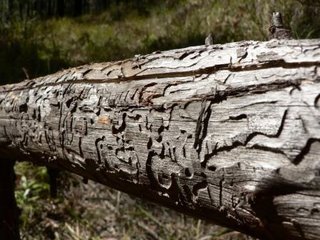
This wattle is bored, too.

There's a world of difference between a bore and a borer.

03 October 2006

Dung beetles to the rescue!

Attention all who love dung beetles, donkeys
and horses.

A new project is rethinking old approaches to worming is a report by Ophelia Keys, another favourite of mine, even if she is just a human and would have put horses first. See some of her beautiful artworks, featured on my other site.

02 October 2006

Bedside books and a public bedside matter

The hotel is a block from King's Cross and described as 'Sydney’s most exclusive boutique hotel ...available to the budget conscious traveller'.

Tasteful, minimalist decor. Above the big inviting bed is a Cocteau poster of a man running his tongue up a man's neck. So far so good. Looking for a phone book, there wasn't one, nor any guidebooks except one book, placed on the tiny bedside table in the cup of tea space —


'PLACED BY THE GIDEONS', the cover says.


The public hospital has a shelf above each bed. And on the shelf is:

The cover says: 'THINKING OF YOU

THE GIDEONS'


These books are a wonder. I always like to open books of wisdom as they wish, and put my finger down as it falls, as that's the best way to get a real feel of the gist of the thing. On the first book, I did it again just now and hit smack in the join of two verses.

'If you fear the Lord and serve Him and obey His voice, and do not rebel against the commandment of the Lord, then both you and the king who reigns over you will continue following the Lord your God. However, if you do not obey the voice of the Lord, but rebel against the commandment of the Lord, then the hand of the Lord will be against you, as it was against your fathers.'


What a different world it would be if this were the bedside book:

Or Robert Louis Stevenson's A Child's Garden of Verses
or Sonia Uvezian's Recipes and Remembrances from an Eastern Mediterranean Kitchen,
or Robert S. Ball's Star-Land
or Mary Kingsley's Travels in West Africa
or the Rev. J.G. Wood's Wonderful Nests

I'm sure that you have a list of books that would be wonderful to meet you, when you are in a strange bed, away from home, possibly at a low point in life and health.

Which brings me to the ongoing postings and discussion in Hal Duncan's blog, currently up to issues of sacrilege, profanity, art, and power in The Power and the Piss.

Now, when the term 'secular fundamentalist' is being used more and more around the world, I think this series is tremendously important, as these issues should be exercising all of our minds since we cannot avoid the consequences of not being involved. The assumption that there is a right of some to shove their philosophies upon our bedside tables is the assumption of all expansionist philosophies, and negates any right they have to feel outraged at their philosophies being disrespected any which way at all. I think it's fair slather to say what one likes to anyone who as a matter of course, negates your thoughts without knowing them, or assumes on the basis of nothing provable, that they have the Truth. Debunk away! Norman Lindsay did it beautifully, and suffered for it. His 'Crucified Venus' shown in Melbourne in 1913 is great art as well as great satire. We tend to forget that 'art' when it's commissioned for an institution, as religious art always has been, is really just advertising that you might like but nevertheless, is nothing more than something less than that original Coke bottle.

So to the following story I wrote, which is a piss-poor piece of fiction.

Saved is as faulty as a trite story can be. It is true in every detail except the tiny details of the protagonist (yes, she was me) and the family she visited. Otherwise, every scene is exactly as it happened, every word, exactly what was said. That's what makes it bad fiction. Life is sometimes such a cliché.

-------------------------------------------------------------------------------------------

Saved


I fell asleep to the clap clap of pig trough doors. All night long under the harvest moon, the sty just a house-length away from bedroom window busy with Erik's pigs imitating the customers at those all-you-can-eat for $6 buffets. The pigs aren't as fat.

The next morning smelt of homemade pork sausages, pancakes and syrup, with Erik at the stove, filling plates for the kids and for at least one brother of Erik or Laurene who'd knocked and come in to breakfast, and maybe also another friend or two. The milk was from a friend's farm up the road. Laurene drove off to work in town, and the minibus picked up the kids, and then the extras for breakfast left, full-bellied; and then it was just Erik and me. There was a daunting mountain of dishes, but he would not let me lift a finger to help. "You're our guest." Said in the same flat tone he says everything except when he and his friends huddle around his pickup in the yard and crack jokes, something that happens about three times a day, as everyone likes to drop by and jaw for a while.

Dishes done, he wiped his hands and stood there with his mitts hanging, and a lost look, until he said, "Laurene and I wanted me to talk to you, so do you have some time now?"

I had all the time he wanted, being a visitor for two weeks, Laurene and I having made a mutually exotic international friendship through her job in an order department years ago, and this being my long-anticipated visit to be with the family physically, instead of just letters and the occasional expensive phone call.

And now Erik stood shift-footed in front of me - a pained man, till I settled myself at the table, and then he shambled over, too.

We sat on the Tahlbusches' wooden kitchen chairs, and Erik's chair ground its hind feet into the floor till the linoleum squawked. Then he had to take care of an unbearable itch on the back of his neck. Then, "You thirsty? Wanna glassa milk?" Well, it took him a while to warm up, but I was used to that by now. So I just waited.

"We're worried about you, Lilli. We pray for you and John every night."

"Oh. Why?"

Now that he was started, he was calm as if he was seated high on the combine. He'd chosen his row, and drove straight. "We're worried you're gonna go to hell."

The linoleum didn't peep under me. Maybe it was just choking. "Oh." I seemed to be repeating myself here, but, whoa, what to say. "Why?"

Erik looked like he wished I had already known, but declared as if he might be struck dead by even contemplating that someone could think this way: "Because you don't believe in Jesus."

I was at this point, thanking something, maybe my stars, that he wasn't a New Yorker. I didn't need to respond for probably five minutes.

Finally, "Well, Erik. You and Laurene have known us for years. Do you think we're good people?"

"Yes!" His face looked pained. "That's why we're so worried. We don't want you to go there."

"But we will?"

"Oh, yes. No doubt about it." And the sun will come up tomorrow morning.

"Have you ever met someone who isn't Christian before?"

"No. But that doesn't matter. You're both going there, because you don't believe."

"Even if we're good?"

"You gotta believe in the Lord Jesus."

"Will a bad person go to heaven if he believes?"

"Yes."

"And a good person won't if he doesn't?"

"That's right."

"Did Hitler go to heaven?"

The clap clap seeped through the walls, as well as the smell of pig.

"Yes, he did if he believed. And yes, he was a Christian, so I guess, yes."

"And we won't, even though we are good people?"

"No. That's why we are trying to save you now."

"Well, Erik." I tried to speak in his same slow measured way, but not growing up here, I felt like a dog with a choke lead. "I thank you for worrying about us, but I know that John and I don't want to go to the same place as Hitler. We'll just keep trying to be good instead, and take our chances."

I looked at his hands, black under the fingernails from engine grease. He'd be back out there this afternoon, fixing its teeth, then cutting his own swathes through the ripe beans, judged by his own fingers and ears to be just at the right phase of drynesspop perfect. A deacon in his own church. A young man respected by all. But Erik thought he was failure as he had not accomplished the mission his church said that each person has: to save those outside the fold.

I think that Erik felt that if he were gifted, he might have made me believe, but his own weakness tripped him. "Do you mind," he asked, quite humbly, "if Laurene and I pray for your souls?"

I didn't want Erik or Laurene to be offended. But at the same time, I could not just shut up completely. "I don't believe in Hell, Erik, other than the hell we make on earth."

Erik was startled. "But where do you think we go?"

"Actually, Erik, I don't care. I only think it matters about this life. But if you want to pray, thank you for your caring about us."

I could tell that he wondered whether God was thinking that he had tried hard enough. "We'll keep trying if you don't mind."

"OK, Erik," I smiled, for this man who wouldn't have taken the liberty of praying for us behind our backs.

—

The days flew by fast as a flock of birds over a barren field. Never was a mention made of our conversation. On Friday, the corn was at that just-right stage for harvesting, and Erik invited me up on the big combine, to see how it's done. Waver, and you ruin the crop. Drive straight. Pay attention. Cut the curves when you come around just right.

Pheasants gorged with corn flew out ahead of us, inches from the combine's teeth. First a swither as they fight their way vertically up through the stalks into the golden-dusted blue sky, then an eruption as they finally appear, long tails trailing, exploding their copper blaze into the bright blue sky. The vibration in the cab was something fearful, my padded behind feeling like it was being tenderized. A glance at Erik, shaken up same as me, showed a serenity and calm happiness that people pay money to try to find. Behind, in a fall of gold, with the sound to match, the corn itself poured into the bins.

Erik was working on a neighbor's plot first as it was the first ready, and a steady stream of provisions kept coming, homemade pork sandwiches dripping rich gravy, beer to stop the dusty thirst, a huge dinner made this time, by Laurene.

Since this was Erik's combine, he gets paid by his neighbors to do their fields, but the provisioning of him is just what people do. The next afternoon, we went to another neighbor's and helped shell corn. Five or six guys all helping to control a house-size pile of cobs, as they funnel into a contraption that looks like it's a breakdown just smiling at you, and it never does, but instead gurgles cleaned off kernels and smoothed off cobs instead. No one got paid for that.

—

That Sunday we went to church. Everyone knew I was visiting, and many looked, in a respectful way, of course.

Every person had on their best clothes, and the backs of the necks of all the men really did shine. Red, chapped, and so clean that God must've been really sitting next to each person. The hot curlers had been busy that morning. All of the women had freshly curled hair, mostly of the same unfashionable but pretty puffed bangs and shoulder-length angelfluff. And almost everyone had that somewhat shiny health of people who eat the food they grow.

Also visiting was a family of missionaries, back for a money-collecting trip from a stint in Mali. Their mission was to translate the bible into the local language, a project they had been undertaking for seven years. The woman was their speaker, and as her family stood behind her near the pulpit, she talked without notes about living in Africa, and their seven years of incredible hardship. Her voice was loud, her words animated, her teeth buck. An hour and a half later, she was still speechifying about what they had to endure, with not a single interruption.

"And the spiders. Big spiders. Get out, you Satan! I beat them with a broom, but they always came back. Satan himself!"

Her eyes were wild, her hate of Africa itself. The extreme dislike of all members of the family for the people there. The disinterest in anything but the bible project.

"And to teach them the scriptures!"

Not a single babysitter works during church hours. Every congregation member, from the week-old baby to the oldest great grandmother, was in the church. Babies that cried, instantly got passed from arm to arm, to the next person, to the aisle behind, to anyone who could chuck the little critter under the chin and make faces, from the front to the back and all around. It was like some sort of musical chairs, with no grizzles or peeps tolerated, but only kindness used to stifle noise. Even very young children sat quiet and patient, while the cant went on and on and on, sometimes wheedling, sometimes fire and brimstone, always nasal.

About an hour after she started, a tiny buzz started up beside me--five-year-old Christine, singing Jesus Loves Me, her favorite hymn, under her breath. Her sister, all seven years of her, turned and put her arms around Christine and quietly dragged her to the floor, beginning a mute game of rock paper scissors.

That's when the tears began to roll down my face. Quiet ones. Every adult member of the congregation had their eyes firmly locked on the speaker. Erik and Laurene noticed something without turning their heads. Laurene handed over a kleenex, as mine was wet paper maché. Not one word was uttered.

When the sound finally sputtered out, just short of two hours, the pastor warmly praised the fine work of the mission, and was the first to start off the basket on its round, so that this fine family could go back and continue to educate Africa and be the foot soldiers of God. Several times, the basket needed to be emptied.

The missionaries took off for another performance during the congregation's wishing-everyone-else-well period, and then it was time to adjourn to the vestibule, where more well-wishing accompanied a brisk trade in bible books.

My eyes were puffy, and from the caring words of the members of the congregation, and the proud looks they threw the Tahlbusches, they radiated pleasure that today, the Lord's Will was being carried out to His satisfaction.

Hal Duncan's 'Still Lives'

This is what a poem can be:

Still Lives

20 September 2006

The albatross

A few weeks ago an albatross washed up on the beach. Its carcass was mostly eaten clean away, but its huge wings and beautiful head and beak were still intact. I think this one was a juvenile 'shy albatross', but I'm no expert.

Even now, it is hard to write about it because it was an albatross.

During the past week, several of these washed up, too. This one was still alive, so it was thrown back. Did it live? I don't know.

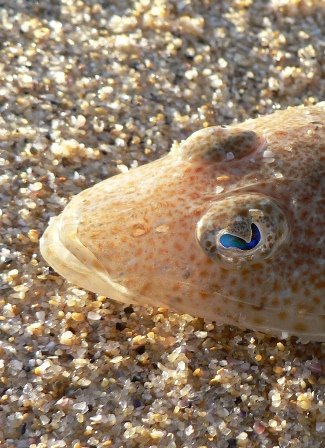
It is a flathead, sold commonly in Australia as characterless fillets. Those extraordinary eye coverings are called 'iris lappets' or 'ocular flaps'. The fringe-eye flathead has another type.

Like other fish, its life is measured by cm.

A fair-dinkum-Aussie test question

Question for the English test:

Where does the apostrophe go in

Princes Highway

Just when you thought it was safe to eat out in Australia . . .

Australia is looking for British chefs, according to The Australian Visa Bureau in its article, Australia deemed pukka for British chefs (the 'pukka' must have been snuck in by some Indian copywriting-centre chap).

12 September 2006

Denature those chain letters

Below is a chain letter that I just received from a friend in India, an otherwise sensible person. As this letter is a clever mix of sense, stupidity, ignorance (such as Lebanese being a language), phobia, historical fabrication and fact-twisting propaganda, I am posting it here so that you can also see its mixed heritage. Much of it is an almost-copy of an American theocratic-Christian chain letter (typical subject title: Be an American).

As Break the Chain shows: "In 2005, unidentified forwarders adapted the message to appeal to international audiences, with Australian and English versions leading the pack."

Australia's Treasurer Peter Costello, who has spouted his own mix of ignorant propaganda, has been a perfect tie-in for these sentiments, so I've followed this chain letter with his own comments and op-ed, and with my own previously unpublished reply.

Now to the chain-mail letter (exactly as received, including the lurid pink):

Arey somebody get this guy to India and make him PM!!!!!!

SOMETHING FOR ALL AMERICANS, BRITS,INDIANS & CANADIANS TO THINK SERIOUSLY

ABOUT.................

Three cheers for Australia

Muslims who want to live under Islamic Sharia law were told on Wednesday to

get out of Australia, as the government targeted radicals in a bid to head off potential terror attacks.

A day after a group of mainstream Muslim leaders pledged loyalty to Australia at a special meeting with Prime Minister John Howard, he and his ministers made it clear that extremists would face a crackdown.

Treasurer Peter Costello, seen as heir apparent to Howard, hinted that some radical clerics could be asked to leave the country if they did not accept that Australia was a secular state and its laws were made by parliament.

"If those are not your values, if you want a country which has Sharia law or a theocratic state, then Australia is not for you," he said on national television.

"I'd be saying to clerics who are teaching that there are two laws governing people in Australia, one the Australian law and another the Islamic law, that is false. If you can't agree with parliamentary law, independent courts, democracy, and would prefer Sharia law and have the opportunity to go to another country, which practices it, perhaps, then, that's a better option," Costello said.

Asked whether he meant radical clerics would be forced to leave, he said those with dual citizenship could possibly be asked to move to the other country.

Education Minister Brendan Nelson later told reporters that Muslims who did not want to accept local values should "clear off".

"Basically, people who don't want to be Australians, and they don't want to live by

Australian values and understand them, well then they can basically clear off," he said. Separately, Howard angered some Australian Muslims on Wednesday by saying he supported spy agencies monitoring the nation's mosques.

United States and Canada..... ARE YOU LISTENING?

Quote: IMMIGRANTS, NOT AUSTRALIANS, MUST ADAPT. Take it or Leave It I am tired of this nation worrying about whether we are offending some individual or their culture. Since the terrorist attacks on Bali, we have experienced a surge in patriotism by the majority of Australians.

However, the dust from the attacks had barely settled when the "politically correct" crowd began complaining about the possibility that our patriotism was offending others. I am not against immigration, nor do I hold a grudge against anyone who is seeking a better life by coming to Australia.

However, there are a few things that those who have recently come to our country, and apparently some born here, need to understand.

This idea of Australia being a multicultural community has served only to dilute our sovereignty and our national identity. As Australians, we have our own culture, our own society, our own language and our own lifestyle.

This culture has been developed over two centuries of struggles, trials and victories by millions of men and women who have sought freedom.

We speak mainly ENGLISH, not Spanish, Lebanese, Arabic, Chinese, Japanese, Russian, or any other language. Therefore, if you wish to become part of our society, learn the language!

Most Australians believe in God. This is not some Christian, right wing, political push but a fact because Christian men and women, on Christian principles, founded this nation, and this is clearly documented. It is certainly appropriate to display it on the walls of our schools. If God offends you, then I suggest you consider another part of the world as your new home, because God is part of our culture.

We will accept your beliefs and will not question why, all we ask is that you accept ours and live in harmony and peaceful enjoyment with us.

If the Southern Cross offends you, or you don't like "A Fair Go", then you should seriously consider a move to another part of this planet. We are happy with our culture and have no desire to change, and we really don't care how you did things where you came from. By all means keep your culture but do not force it on others.

This is OUR COUNTRY, OUR LAND, and OUR LIFESTYLE, and we will allow you every opportunity to enjoy all this. But once you are done complaining, whining, and

griping about Our Flag, Our Pledge, Our Christian beliefs, or Our Way of Life, I highly encourage you take advantage of one other great Australian freedom,

"THE RIGHT TO LEAVE".

If you aren't happy here then LEAVE. We didn't force you to come here. You asked to be here. So accept the country YOU accepted.

Pretty easy really, when you think about it. I figure if we all keep passing this to our friends (and enemies) it will also, sooner or later get back to the complainers, lets all try, please.

And then we have our "gutless wonders" in Washington, India and Britain who are afraid to "take a stand"

-----------------------------------------------------------------------------------------
Now, soldiering onwards! An interview with the Hon Peter Costello MP:
"Australian values, Muslim clerics, anti-Americanism, Telstra"


And the op-ed piece by Peter Costello, exactly as printed (their editing):

"Why the message in Christianity is Australia's heritage", The Sydney Morning Herald, May 31, 2004

Why the message in Christianity is Australia's heritage

May 31, 2004

Church leaders must reassert our core values to arrest the moral decay around us, writes Peter Costello.

When Jesus told his disciples they would be witnesses in Jerusalem, Judea, Samaria and the uttermost part of the Earth, the known world consisted of the Roman Empire - the Mediterranean and surrounds. No one in the Roman world, no one in the Jewish world, knew of Australia.

And yet the teaching of Jesus came to Australia. It took nearly 18 centuries. And we can pinpoint quite accurately the first time the Christian faith was preached on Australian soil. It was preached by the Reverend Richard Johnson, chaplain of the First Fleet, on Sunday, February 3, 1788, under a large tree in Sydney. His text was from Psalm 116 Verse 12: "What shall I render unto the Lord for all his benefits toward me?"

This was the critical and decisive event that shaped our country.

If the Arab traders that brought Islam to Indonesia had brought Islam to Australia and settled, or spread their faith, among the indigenous population our country today would be vastly different. Our laws, our institutions, our economy would all be vastly different.

But our society was founded by British colonists. And the single most decisive feature that determined the way it developed was the Judeo-Christian-Western tradition.

As a society, we are who we are, because of that heritage.

I am not sure this is well understood in Australia today. It may be that a majority of Australians no longer believe the orthodox Christian faith. But whether they believe it or not, the society they share is one founded on that faith.

Unfortunately today we see the legacy of our Judeo-Christian traditions fraying all around us. It is almost as if the capital deposit has been drawn down for such regular maintenance that the capital is running out. The maintenance demands are unending. But we are not building up the capital required to service it.

We despair of the moral decay in our community. Drug barons compete for the distribution rights to sell drugs to our children. We see moral decay in much of the rap music which glorifies violence or suicide or exploitation of other people. My partial view of hell is where people pursue their own insatiable gratification at the expense of and to the destruction of others.

We have such a rich heritage but in so many ways it is being squandered.

What should we do?

At this point it is usual for some leading churchman from some well-known denomination to appear in the media to call on the Government to intervene in some way.

I do not want to suggest that there are no initiatives the Government should take. But I do want to suggest that a recovery of faith would go a long way to answering this challenge. And a government cannot, should not, get into that endeavour. If our church leaders could so engage people as to lead them to faith we should be much richer and stronger for it.

The Bible tells the story of the Prophet Elijah who got despondent about the state of decay all around him. He fled to the wilderness. He sat under a juniper tree and asked to die. He felt alone and thought he was the only person left that was true. But the still small voice of God lifted him and told him there were still thousands that had not lowered the knee to the spiritual and moral decay all around him.

And this is the point I would like to make. There are many that have not, in their hearts, acquiesced to the kind of decay which is apparent around us. They do not believe it is right. They earnestly pray for the expansion of faith and yearn for higher standards.

They are law-abiding, taxpaying workers who want their marriages to stay together, their children to grow up to be healthy and useful members of society, and their homes to be happy. They care deeply about our society.

These people will not get their names in the media. They will not be elected to anything. But they are the steadying influence to our society when it shakes with moral turbulence. They embody the character and the traditions of our valuable heritage.

Their inner faith keeps them going. And they join with other citizens who share the blessings that heritage brought to our country, something for which we can all give thanks. And in doing so we determine that we will not take these blessing for granted. We will not become complacent. We will each to our own ability nurture the values which were so important in bringing us to where we are today and which we need so badly to take us on.

This is an edited version of an address given by the Treasurer, Peter Costello, at the National Day of Thanksgiving Commemoration in Melbourne on Saturday.

-------------------------------------------------------------------------------------------

I sent to this letter to the editors in reply (it was never published).

Subject: Costello's lay preaching

re: "Why the message in Christianity is Australia's heritage" by Peter Costello, May 31, 2004

Arrogant ignorance must be a feature of self-styled moral politicians who equate their religion with their morality. Peter Costello's call to Christian rightists (and their Jewish counterparts) to meddle more than they already have in the nation's politics should be a wake-up call to us here, as there are clearly more intentions to steal democracy from us, as politicians lift up their eyes for guidance, and step on the people's will. Issues like euthanasia have already been decided by this higher authority, so this is not just a ratbag cry for eternal vigilance to rescue some democracy from the Bush-inspired evangelists.

Indeed, Costello's language is inspired by ignorance. He says,

"When Jesus told his disciples they would be witnesses in Jerusalem, Judea, Samaria and the uttermost part of the Earth, the known world consisted of the Roman Empire - the Mediterranean and surrounds."

Yet his known world is as tiny as his mind. Just considering China, for example, he might have the foundations of his attitude to the soul of man and the way he should be governed, shaken to the core.

According to the US Department of Army Handbook on China (CHINACH1.00), China had a highly developed civilization, but it is most interesting to compare the attitude of Christianity to the people, with this:

"Mencius (372-289 B.C.), or Meng Zi, was a Confucian disciple who made major contributions to the humanism of Confucian thought. Mencius declared that man was by nature good. He expostulated the idea that a ruler could not govern without the people's tacit consent and that the penalty for unpopular, despotic rule was the loss of the 'mandate of heaven.'"

The 'known world' in Costello's view shows his own ability to see other points of view, and his interest in looking. His narrowness of outlook and knowledge bears striking resemblance to the world's most powerful man today, a man who prides himself on the narrowness of his outlook, and whose news is filtered for him by his bible-toting staff.

Then, the astounding statement that our nation's critical point of "the critical and decisive event that shaped our country" is a sermon preached by the Reverend Richard Johnson, chaplain of the First Fleet, on Sunday, February 3, 1788, under a large tree in Sydney. would be laughable if it were not pathetic. Bishop Paul Richardson's "Letter from Australia" says,
"When the Pilgrim Fathers landed in New England in 1620 the event was celebrated by prayer and bible reading. By contrast when Governor Phillip landed at Sydney Cove on January 26th, 1788, no religious observance marked the occasion. As one historian described the scene, 'The baptism of the place was performed in libations of liquor and success to the settlement was duly toasted in the flowing bowl.' "

There are many reasons for the failure of the churches to establish themselves at the heart of Australian national life. Settlement began after the Enlightenment had undermined faith in revealed religion. A large proportion of the early settlers were convicts and the Anglican clergy were part of the unsympathetic establishment. One of the first Anglican clergymen to work in New South Wales, the Rev. Samuel Marsden, was popularly known as the 'flogging parson'. Australia acquired the reputation of being 'the most godless country on earth'."

Costello's view could be dismissed, if it weren't so dangerous. His reference to Judea and Samaria is a key to understanding the Australian government's attitude to the landgrab and atrocities committed in the name of Greater Israel, a cruel folly perpetrated under the banner of "God gave it to us". This religious fanaticism is a crucial part of the severe problems we face today, as religious moralists try to shape the world to fit their fanaticisms.

In fact, millions of us should demand an apology for the assumption in Costello's statement, "There are many that have not, in their hearts, acquiesced to the kind of decay which is apparent around us...Their inner faith keeps them going."

As an alternative to Costello's political/moral view, I urge Australians to look again, north, towards India now, where 350 million people recently voted. The mandate was for secularism. And though Indians clearly haven't seen they light, they can't ALL be bad.

(signed) a non-drug-dealing, non-rap-musical, irreligious democrat,
(name, etc.)

-----------------------------------------------------------------------------

Well, that's about it for this post, except to say that the next time you get this sort of stuff sent to you, denature it.

But let's not end with a sermon, but a bit of poetry:

They say that things on earth awry
Will straighten out beyond the sky,
And what we know as margarine
Will rank as butter by-and-by.

A.G. Stevens, 'Hard Lines', in The Pearl and the Octopus (1911)

08 September 2006

Diaphanies: Native indigo and bee

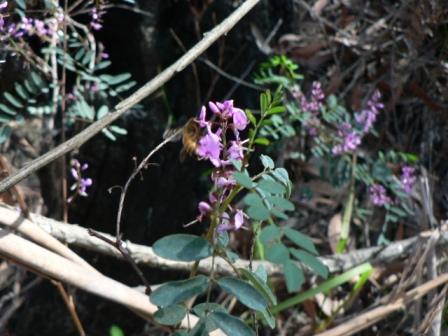
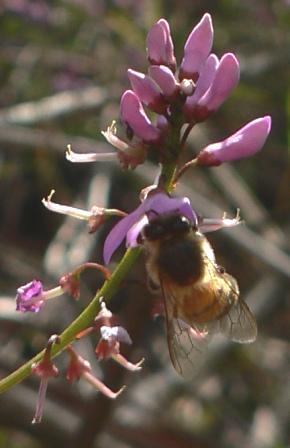
One of the loveliest sights of spring, the flowering native indigo.

Botanical Name: Indigophora australis Family Name: Fabaceae

Native bees are much smaller than these. You can read all about Australia's honey industry and the many honeys from native trees and plants here.