28 June 2006

Of rats and mien

A joke so old, you may not know it —

At a diner, two friends are ready to order. "I'll have the tongue," says one.
"Yech," says the other. "How can you eat something that comes out of an animal's mouth?
I'll have eggs."

Rats get worse press than tongue, yet I've seen them sold in three open-air markets as meat.

The first was a busy market with many traders behind trestle tables piled with tomatoes and avocados, chillies and cilantro, tubs of fresh white homemade rounds of cheese, baskets of crusty loaves and sweet rolls. Clean pieces of meat lay on some tables, hacked simply, their sellers flicking away flies. On one table were several rats, pink and glistening, lying on their backs flat as 1960s suntanners at the beach. — Mexico, 1976.

The second was in a forested area in Europe where the women wore tight embroidered bodices, cinched waists, long skirts and masses of petticoats. Everything there was built of wood, carved and painted Kuntry Kitsch'n style, but this was a world away from home decorating shops. This particular market sold meat. It had a number of stalls ranged around a little central yard, and against a wall was posted a curlicue-lettered sign with the meats and the prices. First on the list was pork. Second: beef. Third: rat. As we looked around, a woman squatted in front of us, her wide skirts spreading as naturally as a mushroom rots, and she got up after a moment and walked away. — Romania, 1980.

The third market was, time and place: the very model of a model modern market. Local farmers stood behind tables quite like that market in Mexico, and on the central table in the front ranks of smiling sellers lay two rats. They were bigger, but as pink and glistening as the Mexican rats; and like the others, these were skinned to perfection — naked as skinned rabbits, shinier than sturgeon roe. They were also on their backs, their long tails straight as pencils.
— The Economic Territories near Hong Kong, Chinese-government bus-tour stop, 1990.

Each time I saw meat-rats, they were proudly displayed, almost totally beautiful, and they made your typically goosebumped, slackarsed chicken look like a horrorshow star in comparison. I admit, though, that there was one thing I found disconcerting. Their long teeth were as yellow against their skins as the natural fangs of pale blonde actresses. Perhaps if their teeth had been capped . . .

24 June 2006

What they're wearing this winter


All day long they do nothing. They hang out in dark corners if they can, and if they can't, they keep out of the sun and warmth.


Moths are to butterflies what tugboats are to yachts. I've always loved tugboats. They have so much more depth of personality than yachts, working usefully without bragging about it; and if we could hear moths, I like to think their voices would be as deep and stirring as a tugboat's.

Moths live lives of great intrigue and touching vulnerability. They are elusive as many a rationale, in their element.

Many Australian moths are furrier than all but the warmest-garbed animals. And I do love fur. Their markings and feathered antennae are often more beautiful in a quiet way, than butterflies. Moths possess a Jane Eyre elegance, which seems appropriate as they sometimes look clothed in Victorian cashmere.

Sometimes it's hard to see which visitors of the previous night are resting and which are dying or dead. After a busy night last night, today this one moved one leg.

Last night a little sugar glider jumped and ate several moths, each one as big to the glider as a turkey, to you.

20 June 2006

Medlars: their innies and outies

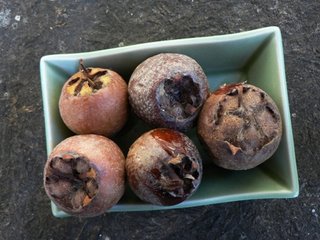
The medlars were picked when they were ready to be picked, which means that they came off the tree easy as apples when they are ready. A little twist or a shake of the branches, and medlars come tumbling down. They bounce. They are easiest to gather (and find) if you check the ground for windfalls, and then spread an old sheet on the ground as you pick or shake. Medlars do fall to the ground without having bletted on the tree, but if you want them to blet on the tree before picking (as is advised elsewhere), then plan to suck their guts off the branches, as their flesh will cling to the tree when you pull the soft, bletted medlars off, and you'll come away with skins and mush. Otherwise, pick them when the leaves have fallen and the first medlars have fallen, too, or are easily shaken off. They will still be hard. Blet them in straw if you have it but if you don't, then they are not perturbed. Unstuffy fruits, they'll blet tumbled into a cardboard box.
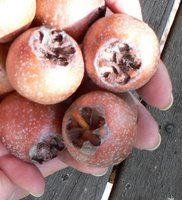
They will blet as they will, each medlar choosing to ripen to delicious rot in its own time.
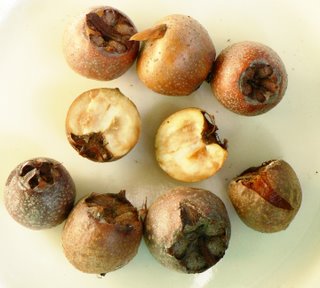
Unripe medlars (such as one cut open above) taste like snakefruit (another fruit that is outstandingly delicious as well as beautiful) but with added astringency. Unripe medlars were once so famously inedible that this characteristic succoured poets in the days when poets craved easily digestible metaphors.

Much has been written about the proper way to eat a bletted medlar. Peel a medlar, some say. Others: Eat it with a spoon.

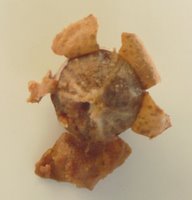
This is a bletted medlar, peeled.

If you peel grapes, then do peel a medlar.

Otherwise, nip the medlar in its side as if you are a vampire and its tender, turgid, russet-skinned being is a plump neck. Now suck its guts out.

Or squeeze.

This is a bletted medlar, nipped and squeezed.
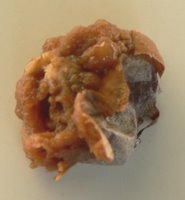

Now savour its complexity.
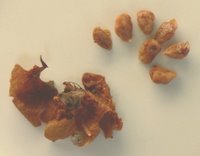

The skin has as much character as the skin of a good yam. And those are the pips. If you can spoon out the flesh of a medlar, you can probably do anything.

Medlars are innies until they overblet, at which point some become outies.

As can be seen above, there is often an anticipatory ooze that exudes from a medlar in just the right state for your pleasure. The ooze is the best candied jelly on this planet.

As for things to do with medlars other than eat them naked as they were born, they have been made into pastes and jellies, and folded into cream to make a fool.

Pastes and "cheeses" and jellies are delightful, and I love fools, but to my taste, these dressed-up versions slight the beauty of the naked medlar, and more importantly, imply that the medlar is like other modern fruits: bled of individuality. The essence of the medlar, and its charm, is that complex individuality.

Every medlar tastes as it will. It blets in its own time. Its texture and taste are unique and often contrarian. For these reasons, I prefer to eat medlars, guts and all, one by one.

They don't mind company, however.

Citrus becomes them, finely cut skins of mandarin (tangerine) especially, or whole kumquats. Uncandied, in all cases, as added sugars dull the sweetness in the medlars, and medlars are richly sweet. Walnuts are good company, as is wine, the kind of wine that furs your teeth, as any good wine does. If you make a paste of medlars, I don't recommend adding spice, but if you must, don't, please, use cinnamon, as it makes medlars taste like insipid apple. Cardamom brings out the flavours of date and fig and pear and spice that all live in each medlar's world of taste.

I once made chocolate-covered medlars. Absolutely disgusting. The medlars revolted in protest, going past the blet into full ferment. They served me right.
~~~~~~~~~~~~~~~~~~~~
Some other posts here on medlars:

Medlars are such characters.
They often appear in my fiction, sometimes in cameos, but in these two stories, they have prominent roles.
17 December 2011 news
"Valley of the Sugars of Salt" has now also been published as an 'ebook single" by infinity plus, available from Amazon UK, Amazon US, and Smashwords. And if you like ebooks, you might prefer to have this story as part of the infinity plus bumper e-dition of Monterra's Deliciosa & Other Tales &)

And let us not forget those mistreated and spurned vegetables
May I recommend, oh friends of unusual discretion, my freshly published "Cardoons!"
"It didn't look cannable. It didn't look boilable. It looked like it could fight monsters, and win."
Yes, this new long story is in a journal of horror, but please don't be put off by that any more than you are from what more than some people think of as the "swollen dead body" aspect of a perfectly bletted medlar. When the world recognises the yen we have for neglected-fruit-and-vegie fiction, we'll get our own genre. In the meantime, we've got to camp rough.
Not that there aren't gollops of horror in Cardoons! — but one person's horror is another's irresistible temptation.

01 June 2006

A.C.E. Bauer, on copyright

Making Light's discussion about fanfiction and copyright, and Hal Duncan's subsequent contribution to the 'kerfuffle' prompted A.C.E. Bauer's "In the rabbit hole" column this month:
Copyright won't give you an hourly wage

The mystery coat, a rainy day, and essences

Several people asked me about the coat that I featured in my other site last month. Here it is again.
It belongs to Jenny, who is the middle unhappy person in this group portrait of today.


It is a gloriously wet day, one of the few we've had over the past years. Glorious for some, but every drop of rain falling upon these coats is a Greek tragedy to the wearers. Bleakness shines from their eyes. Their ears are eloquent.

I wish you could smell them now. When wet, their essence is most alluring. Jenny especially, smells like crushed cardamom and coriander, and she wears her perfume better than any human I've ever known. (It fits her scent that her favourite food is rich fruit cake.)

But she isn't unusual. Many others smell better than humans, no matter what we put on ourselves. I knew a cat who smelled like a better-than-any-that-is-sold baby powder, and another cat who, if Hermes (of the silly scarves) could have crushed and bottled her . . .
and one day, after another spell of rain, a frog:

Safe Haven

Nestled in the spaghetti colander on the rain tank's top,
where roof-water sluices from the pipe — a frog.
The grey of mottled eucalyptus bark
invisible there but not so safe
to kookaburras patient as stones.
Fast as frogs, they flash.

The size of the palm of a child.
Underneath, a swaddled celery green.
Damp rubber toes and fingers curl around my finger cage.
Dappled grey eyes grasp me
with the calm query of an old grandfather.
And when I stretch his back legs gently, just to look
(to his unnervingly dispassioned gaze) a flash
into his private world. A stripe
for showing in the briefest
moment of his fullest leap.
Signal yellow, round black spots
like a very shy man's underpants.

I took him to the dark, damp sheltered gully.
Palm open as a lily pad, I sat, and the frog sat, too,
just watching me, and who knows, meditating?
No wind, no sound.
Then suddenly, he hopped and disappeared
deep into the humus.
I nosed my hand and it smelt like
Christmas sugar cookies (cardamom)
lightly brushed with eucalyptus, lemon,
and a hint of tea tree leaves.

31 May 2006

Suu Kyi on the road, August 2000 (that long ago?)

She's out again, that woman
and without a speck of humour,
a fingerpinch of om.
She hangs her tarnished prize around our necks
and it stinks;
a carcass of a cause
dead to our enthusiasms
because, well you know
that was sort of ten years ago and we've passed on.
Fun, she isn't.
Smiling, she lectures us
and we don't like it.

"Less talk and more action"
she has the effrontery to say.
It rankles because we cared
we really did.

But she's still singing the same old tune
without even a sexy little ring to it.
Pragmatically speaking,
we have grown and she has not.
That must be why she's doomed
to sweat in that car,
holding on as long as she can,
and then when she cannot,
reaching for the potty.


At least something has improved. We don't see and hear her any more, especially now.

As much as we’d like to pretend that actors’ real lives don’t matter, we know it’s not true. We care. - Paige Ferrari, in a headline story today in MSNBC, Brad vs. Vince, Who's the Money

05 May 2006

Have you seen the Circus of the Spineless?

If you haven't, then only death should stop you. Is that in bad taste? Not at all, to the earthy performers in this circus, some of whom would find you very tasty indeed.
Go to the Circus

That memento mori: The big picture and little things

JP commented on the memento mori I posted a few days ago, so perhaps you want to see the full picture, as the first picture was cropped from this.


Although I'm quite taken with the neo-Mannerist Lady of the Tripod, my own taste favours the spider, and only a touch of the shell and the watch. There is yet another spider that attached itself to the cord and died, but it is so small that I don't know if you can see it. A pity.

From small things, big things grow, the saying goes.

Yet the big thing, I think, is the small. The world's greatest wonders and most powerful forces are so small that they can't be seen with the naked eye. Everything big is composed of small, and without them, that big thing would be a nothing.

You're most likely to be killed by something that needs an electron microscope to view it, not a telescope.

Michelle Richmond, writing in the San Francisco Chronicle, talks about her son, Oscar, in an essay that is extraordinarily beautiful and funny — and fragile. I want to cheer for his parents who, like their son, look at things with an abnormal perspective. They see dignity where others would crush it underfoot.

At 8 1/2 months, he pays no mind to horses and windmills, fire trucks and Ferris wheels, gigantic cartoon characters of the sort one finds in low-rent pizza joints. He does not care for anything of stature, excepting his father, who, at 6 feet and change, registers on Oscar's line of vision only when sitting down. What my son notices are those things small enough to be contained in multiple in a matchbox . . . perhaps he will be a great miniaturist, or a microbiologist or entomologist, destined to champion the dignity of small things.

Hopefully, Oscar will never grow out of this fascination with the small. I suspect that he will be short-sighted, and that if he is lucky, he'll have abnormally fine close-up power of sight. I did, till a few years ago, and what I could see with this vision has always been precious to me. Lichen flowers, the hairs on a piece of lawn-grass, parrots' eyelashes, the mites on a dung beetle's fur. Normal sight, however, was never something I possessed, and so, possibly like this baby will, I wore glasses for most of my life. Next week, I'll be getting my eyeballs' lenses replaced in a supposedly common procedure in which the eye's lens is removed and replaced by one of polymer. The reason for me is cataracts. The result, supposedly, is great though not perfect sight. Normally, the result is tuned for better far vision than close, and reading glasses are needed. I've wanted to keep the short-sightedness and don't give a damn for the far.

I've fretted about this result so much that I'm a pain to be around. Will the short-sightedness I still possess be lost? It used to be fine as a jeweller's loupe (almost eyelash close), though I couldn't see to the end of a ruler.

Last night I dreamt my fantasy — two different lenses inserted, and a black patch to wear. The left eye gets 'normal' vision, with even the beautiful shattered glass of astigmatism eliminated. When I wear the patch over that eye, though, I can see like an electron microscope.

I wonder what Oscar will dream of when he grows big.

04 May 2006

Argument with the mechanic

"Poor dear," he clucked to the tractor while he gave her a rejuvenation treatment. He has only just given us the bill for that, and it looks right. But only a while ago I had quite a time with this mechanic, arguing with him over the bill for our car.

It looks like just a car that is older than most in any car park, though not older in any romantic way. She needed her annual check-up for registration, and a service.

The car is a 'she' to him, the mechanic. If she were a human, I'd get a rundown on the state of every twist in the gastro tract. Since she's a car and I'm clearly more interested in biologicals than mechanicals, he teaches me patiently that she's alive, too. He's actually made 'her' interesting, and I have begun to think of this machine as something more friendly than the one I'm using now (Can any computer be a 'dear'?).

This car service was overdue, as problems had added up. Quite a bit of work was needed to keep the car going — and parts needed to be replaced. The parts added up in cost (no profit there to the mechanic) to about $200. He was quite upset that they came to so much. So he discounted his own work to keep the bill down, till his work was almost nothing. "Don't cheat yourself," I said. "I can't accept this."

"I can't charge you any more," he said. "I can never expect to make money. After all, I only work with my hands."