14 March 2012

Prizes encourage them - the success of self-loathing

What's more stale than a continental-breakfast roll in a package-tour hotel, less original than a dollar bill, and most deserving of a rubber corndog up each arse as the comfits for the judges?

(in my op.)

However
"It's the best short story of the year by an Australian crime writer," says Nevada Public Radio, "that gives a noirish twist to our fair city - it's a dark tale of hookers and death in the desert". Listen to their interview of the author, A.C. Patric — about this rising star of the Australian lit scene, and his soon-to-be-published collection, Las Vegas for Vegans.

Of course, not everyone has literary/cinematic sensibilities, or can understand the art of creating imitations and of imitating imitators. And like, you know, you don't need to visit the future to write about it. Anyway, some old bat calling herself 'aunty palin' complained: "It really spoils it for me that the author has never visited Vegas.

Read an edited version of the story, Fear and self-loathing, in Australia's premier newspaper, the Cultural Cringe Sydney Morning Herald.

The prize this story won is the inaugural Ned Kelly SD Harvey Short Story Award, which might make dead-Ned laugh. His legend is more full of shit than a feedlot.

12 March 2012

Freed of a title


"We refuse to be called anything, nor to get manipulated."

So they got their way.

11 March 2012

Review of The Company of the Dead by David Kowalski

Newly released in the UK, to be released in a couple of days in the US

I just posted the review below on Amazon UK, but what I didn't say is that I thought so highly of this novel when it was first published in Australia that I bought a couple of copies and sent them to a couple of folks in the US, hoping that they might review them and then possibly, a novel that should be published there, would be. The problem with that, though, is that this is a book for readers, not reviewers (who must look at 800-page books and think I could read 3 to this 1).

It's a meal and a half. So I highly recommend it for all those of us who love to indulge ourselves. Even reviewers!

Oh, and I should say that I did refer to David as 'the author' in the review, but he has become a dear friend over the years. However, his ability to write a novel plotted better than any war-room or cutting-edge motion-capture, and with seductive flow, doesn't mean I won't criticise that which I think he does poorly. When he wears a baseball cap to try to take 50 points off his IQ, it doesn't work.

Onwards!

Every reading will be newly rewarding

I usually hate both mysteries and twisted history because the mysteries depend on overly complex and ultimately unbelievable contrivance -- and the twisted histories, on simplistic and superficial pop myths we hold to be true. And I have also grown to hate novels that you could use as bludgeons.

So The Company of the Dead should have failed on all counts. Yet on all counts, it failed miserably to dissatisfy. It is a quite enthralling page-turner, filled to bursting with mysteries that are as natural to the story as wet is to the sea; action that you can see and can't help hear as you read; places that are so real, you'll probably (as I have) dream you'd been there; and utterly fascinatingly lethal toys-for-boys (and girls! which doesn't decrease lethality one bit). The author steers us through history with expert but unobtrusive authority. Best of all, the depth of story and characters is quite unmodern, in that this is the Great American novel that Michener would have wanted to write and almost did with his first novel; McCarthy has been trying to but hasn't quite reached, I think, because his novels are too one-dimensional emotionally; and Americans sure aren't likely to now, unless they free themselves of the whirlpool of the Iowa Writers' Factory, Tin House -- and all those schools of artificial artsmanship, posed amorality, and characters who can ultimately, only aspire to be handmaidens to an author's ego.

That the author is an ignorant first-time amateur who isn't even American but whose personality is obsessive about anything he gets into, probably saved him as much as (to name a few) Naguib Mahfouz's, Charlotte Perkins Gilman's, E. Nesbit's, Jack London's, H.H. Munro's, Winifred Watson's, James Tiptree Jr.'s, R.K. Narayan's, Raymond Chandler's, Laird Barron's, Jeffrey Ford's, Lucius Shepard's, Steve Aylett's, and (a novelist I have great expectations for) Jennifer Rohn's life experiences made them creators of what great reads can be, reads that are so multifaceted that they become like true old friends -- always well-met, and yet every time, leaving one with a feeling that there's more under the surface that we've still to appreciate.

This novel could have actually been longer than it is, as there is never a padded page. The characters are larger than the book, which itself, is larger than one unforgettable film. That the author assumes that readers are interested in history, place, in depth of character, in questions of what-if that go beyond celebrity and momentarianism, shows a wonderful respect for the public, and an optimism that I hope spreads further in the book and film trades.

~ ~ ~/

&
Have fun at David Kowalski's new blog. His first post is a trip into paranoia:

Top 5 Titanic Conspiracy theories…

09 March 2012

A t-shirt to love & wear, even if you don't like *him*

The lust that any being must feel for the Lovecraft eZine t-shirt that you can win reminds me of the time my uncle found a greeting card so attractive that he bought and sent it, crossing out the irrelevant to all of us including him, "Merry Christmas".

I think the shirt (great designs f & b, Leslie!) goes best with things that drip and make odd noises, including lovers in the rain—but this drollery (for beings with two arms—sorry, others) could be worn anywhere and face or turn its back on anyone/thing, even a/t's who think Lovecraft, who? but love the fontplay.

And the best thing about the t is that it comes from a place where visitors will be captured, played with, and consumed by the contents—even if those visitors might have wandered into Lovecraft thinking they were the consumers, and were going to romp out with, say, a teddybear-making kit, includin the stuffin.

The Lovecraft Ezine itself is the spawn of a crazed love, fueled by the passion and undeep pockets of Mike Davis. Your help could keep the zine going, which means: help away!

There are two other reasons I'm writing this post.
  • I highly approve of the style and attention to detail that Mike and his cohorts put into this newish magazine that quite uncommonly, has style as well as substance.
  • I've been dogged. Upcoming in the April issue (I'm delighted to announce) is my report: "The Dog Who Wished He'd Never Heard of Lovecraft"

08 March 2012

A guest-post by a librarian who loves matchmaking

I LOVE my new job!
by Edwina Harvey

Late last year I left the university library where I had worked for 30 years.

I’d seen a lot of changes over that time. When I started, we were still using hand-written loans cards, and knew most of the students and academics by name. We got to know their lives and what subjects they were interested in so if we saw a new book or magazine article they might want to read, we could point it out to them.

When I finished, paper-based knowledge was being discarded. Not offered to people who might consider it of value, but dumped as landfill because it was considered inferior by the managers of the establishment, though text books were still being borrowed and old printed journals researched because their contents aren’t on line yet. The specialised service we used to be so proud to give had been eroded away. You aren’t expected to get to know your clients anymore – there’s not enough time. Statistics are kept on how many customers you’ve served in an hour, not how well you’ve served them, not how satisfied they are that their questions have been answered and their needs met.

We encouraged library users to borrow their own books at self-serve stations not dissimilar to the Do-It-Yourself pay stations creeping into more and more supermarkets these days, and there were plans being put in place that borrowers also return their books through the self-serve units too. Students pay a lot of money to go to university, surely they deserve a bit of service for investing in their future?

I thought I’d find it hard getting another job because of my age, but through a stroke of luck, I met an acquaintance who remembered I worked in a library (or used to). Would I be interested in a bit of casual library work at the Sydney Mechanics School of Arts? You bet I would!

A few years ago I first visited the SMSA library, and found it a bright, welcoming space—and it's right in the centre of Sydney. On first sight I thought it would be a wonderful place to work. Now I have that opportunity.

Not only is it a beautifully appointed library, but the two librarians who run it believe in the values that drew me into library work in the first place: they feel it’s important to get to know the library users by name, learn their interests so they can say, “Here’s something I thought you might be interested in.” The emphasis is on how well you can serve the people who use your library. I’m in heaven! I’ve found a bastion of civility and friendship.

The SMSA library isn’t large, but it’s not crowded either. It’s devoted primarily to fiction books, though there’s some non-fiction such as books about Australia. Magazines are also on offer. Two internet terminals sit on a nice wooden desk down near the windows. Members are requested to limit their time on the computer to 30 minutes a day. If both terminals are occupied, other patrons wait patiently for their turn to use them. Coming from a university background where arguments over computer usage regularly broke out, this polite, genteel approach is a wonder to behold for me.

I was recently challenged about my feelings on the library not supplying DVD’s, audio books, e-books and the likes. My feelings are that a library exists to meet the need of its patrons. And as the SMSA has been going for 179 years, clearly its library does that.

To be able to borrow from the SMSA library, you need to join the association, but the annual fee of $15 ($10 concession) entitles you to discounts for talks on a wide variety of subjects held on the premises, to attend the AGM and other meetings, as well as having access to the library. As the loan period on all but new books is 8 weeks, members from Sydney’s outskirts who can’t get into the city regularly have the opportunity to borrow. The longer loan times also suits slower readers – like me.

I don’t know how long it will take me to learn the names of the regular library users, or their reading preferences. But I LOVE my job! It’s so good to be working in a library where books and the people who enjoy reading them are valued.

Edwina Harvey has worked in a university library in Australia for 30 years. Recently she started working casually at the SMSA library, and reconnected with the passion that drew her to library work in the first place. Edwina is also a writer, editor. ceramic and silk artist. You can view her work at www.celestialcobbler.com

That was the bio she gave me when I asked for one. But I'll add that
  1. I asked her to write this piece because she is so passionate about matchmaking.
  2. Edwina Harvey is also a writer of fiction.
  3. I highly recommend her children's book The Whale's Tale—but don't take my word for it. Read Rod MacDonald's review in SF CrowsNest. I nagged Edwina to make this attractive softbound edition more easily available internationally—but like most Australian-published works, international postage snagged possibilities. So now I'm delighted to announce that The Whale's Tale is now sold as an ebook by another favourite of mine, Cheryl Morgan's Wizard's Tower Bookstore.

I LOVE also recommending these sites:
Heather Morrison's The Imaginary Journal of Poetic Economics.
"Imagine a world where anyone can instantly access all of the world's scholarly knowledge - as profound a change as the invention of the printing press. Technically, this is within reach. All that is needed is a little imagination, to reconsider the economics of scholarly communications from a poetic viewpoint."
Morrison and her like don't just imagine. It takes a lot of work.

John Klima's site and his links

Better World Books

21 February 2012

I sentence this sentence!

"An Indian court has remanded two members of an Italian navy security team accused in the fatal shooting of two fishermen in custody for two weeks."
— lead sentence of today's BBC story India court keeps Italian navy guards in 14-day custody

Does this save it?
An Indian court has ordered 14 days of judicial custody for two members of an Italian navy security team accused in the fatal shooting of two fisherman.

What's your suggestion?

Have you also noticed that the adjectival form is hit and/or miss whatever, when it comes to the non-pukka nations?

Reuters should make headlines for their headlines.
Here are two beauties:
Mexico court approves Vitro restructuring plan
Lead sentence:
A Mexican court approves ...

Turkey court frees 22 after anti-government protest
Later in the story:
Police raided their houses and found left-wing tracts and pictures of executed Turkish leftists.
A related story listed below that one, also Reuters, is:
Turkish court agrees to try former top general
Anything goes!

In contrast, see if you can find the same sort of treatment for "America court".
I couldn't. Even the Times of India is — what? Old-fashioned, stick-in-the-mud pedantic?

But then, if you were interested in English, you would be brave to venture into the BBC with its
"Easy tiger!" lesson which includes "Hi Helen I like your hair." (Was the punctuation shot?)

Instead, I recommend S. Upendran at The Hindu, and Jose A. Carillo at The Manila Times and his English language forum.

"Next, make yourself thoroughly familiar with the various tools of English for putting words together into grammatically and structurally correct, coherent, and clear statements. Don’t be content with just being knowledgeable with the English content words—the nouns, pronouns, verbs, adjectives, adverbs, and interjections. You absolutely need to master the rules for using them, but always remember that they only work as carriers of the meaning that reside in each of them."
— Jose A. Carillo, in answer to "A letter from a Filipino freelance writer in New Zealand"

19 February 2012

Of frogs and eyes and pobblebonks

This has been the summer of frogs. This little tree frog was outside the window last night. Through its translucent skin, its heart rate could be seen as easily as the joints in its toes. On the veranda, two other tree frogs were hunting moths. When a dung beetle flew in, it was grabbed so fast I never saw the mouth of the frog open. But I did see the beetle dragged, its leg clamped in the frog's mouth, and the frog backing into the shadows. Was the beetle et? That will remain a mystery. The beetle was almost as large as the frog, whose eyes, being a frog's, were almost as large as its stomach. The gulp, with the frog's eyes pushing down the beetle—if this is, in fact, a frog whose eyes retract—would have been quite a sight.

Robert P. Levine, Jenna A. Monroy, and Elizabeth L. Brainerd must have many happy hours in their lives, due to their dedicated observations. They are the authors of "Contribution of eye retraction to swallowing performance in the northern leopard frog, Rana pipiens", in The Journal of Experimental Biology, March 15, 2004.

As to species, this is the best part of nature for amateurs like me. It gives us great excuses to buy guide books; and no matter how many we have, they are never enough. I can tell you with assurance that the frog above is not a Peron's tree frog, whose belly is merely 'smooth'. And I think that the two hunters on the veranda were Tyler's tree frogs, the larger one with the aspirational appetite being the female, and the small thin one the colour of a cucumber that is left too long and gone yellow, being the male in "breeding colouration". I hope I'm right, partly because their other name is Southern Laughing Tree Frog. The thing is, if this is true, then the female has been visiting on her own for weeks, pretending to be a Peron's.

But if only you could have been with me a day ago, when we both could not have seen but heard — a pobblebonk. Like some people, you don't have to see a pobblebonk to know it's unmistakably there. But a pobblebonk is a treat to hear.

And I highly recommend this dramatic feast for all toad lovers. This is one of my favourite passages in literature, so much so that I've made it a feature in my Virtuous Medlar Circle amongst the classics to enjoy rather than think you should have read:
Martha, Jane, and Babbette, a true story from A Farmer's Year by H. Rider Haggard

14 February 2012

A def of classical music?

"You can tell this man rarely listens to anything released later than 1987."

I didn't know that Jayaprakash Sathyamurthy is a musician in addition to being a writer of both commentary and crackling fiction (read his most recently published story, Run For Your Life, in Pratilipi, a bilingual literary journal.)

But in

Djinn & Miskatonic: the first three months

he talks gigs, sets, and is modestly pleased that "There were even a couple of people headbanging to our lugubrious tunes."


12 February 2012

The fountain-pen-mimicking hoverfly

This Micusfonsscriptus needs a refill

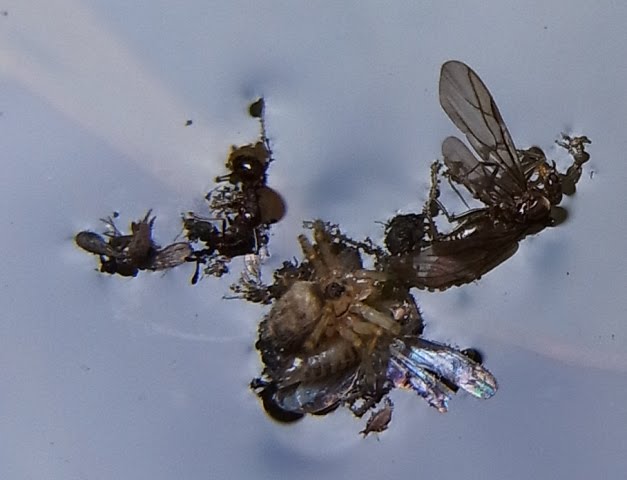
Since this hover fly (otherwise known as hoverfly or syrphid fly or flower fly, or—by most people, a wasp, which would be a mistake) mistook a paper on my desk for a toilet, I've taken the liberty of naming it with a name that is, I would bet, more accurate though linguistically inept, than the name it most likely bears in ignorance.

For who amongst the odd visitors here who have perched for a moment, doesn't love the feel and look of a fountain pen not made for people who love gold and glitz, but the pure pleasure of ink flowing from a pen onto a receptive sheet.

This Pelican needs feeding, too.

Of course, if anyone can put an official name to the beautiful creature above, I'd be grateful if not exactly thrilled. For vicarious thrills, see Mark Isaak's delightful Curiosities of Biological Nomenclature.

Medlars shower hails upon Jeff Sypeck

If medlars and gargoyles had bestowing rights (not to mention all of us including the ghosts of Chaucer, Seuss, and Carroll; all who value the fun, the pun, the music, the raucously empathetic life condensed to verse that runs over your tongue like a brook over stones—instead of Iowanic tripe or poetry is anytng you rit n cl potry)—Jeff Sypeck would be given the post of poet laureate instead of those who do.

Medlars everywhere are celebrating this jongleur's latest "Medlar song"—though some look a bit astringent at having to share the bill with another photogenic gargoyle, even though Jeff posted an excellent before/bletted portrait of a few of these stars.