31 January 2013

Do spiders fear other spiders?


This young huntsman was no match for the insignificant-looking daddy-long-legs who was busy wrapping by my desk, and from whom I stole this prize. To me, a home is not a home without a huntsman on the wall. They are particularly helpful keeping down the black house spiders that prefer the great indoors to those of out-. And we cheer when they bag a daddy.

A dare
Say "Who fears a Pholcus phalangioides" 3 times really phast.

28 January 2013

Darlings, you're choking me! Chouchous and chokos gone wild

In French, chouchou is a term of endearment, and this vegetable is also so loved by the French that when they claimed the idyllic Indian Ocean island of Réunion, this versatile cucurbit Sechium edule, known by many names including chayote (squash), christophine (or -ene), merliton (or -leton), chu-chu, (and choko in Australia) was one of several winners that have since, transformed the steep and verdant mountains of the spectacularly up-and-down Réunion. The story goes that the first plants were shipped from Rio de Janeiro to what we now call Réunion Island (it's gone through many names) in 1834. Like the English when they came to Australia, the French thought nothing of keeping the virginity of this new land sacred. And chouchou grows like a weed, even on the steepest slopes, so it made marvelously cheap slave food. Chouchou au gratin is a favourite dish there in both restaurants and at home, and is considered a classic in the Réunion Creole repertoire. But you could gratin cardboard and it would taste divine.

Like the slaves on the island, chouchous escaped.
Feral chouchous looking down on Hell-Bourg, Salazie, Réunion Island

Chouchou is an important agricultural crop, one which was hurt by Cyclone Dumile earlier this month. From the Google translation of the report:
"...The agricultural economy has also been hit hard. In the east, many producers reported losing virtually all of their harvest. Dumile and ended the season of mangoes and farms darlings Salazie are also devastated. Agricultural Chamber of Reunion laments 40 million loss for farmers Reunion."
Chokos, although never exactly popular in Australia, were nevertheless, widely used, mostly to make choko jam but also to boil to grim death. Choko vines were a common lounger on innercity paling fences, dropping their fruits right beside the dunny (outhouse).They are much more expensive now, now that that type of neighbourhood is history. But chokos have never lost their fascination to me. I like to eat them raw, but often leave them to age because they have such personality. That inclination to go wild when no one is looking ...


Old chokos never die. They just go draconic.

Postscript: 30 January
This portrait I made is for 'Nora, because of her comments below, but to the rest of you, I highly recommend you sidestep over to one of her typically fascinating and intriguingly titled posts, "Spilled coin purse and a flower"—about black-eyed peas and rice, and more.

The Judgement of Pears

27 January 2013

The next small thing

"curry punk" (Piptoporus australiensis)
Of the many Australian bracket fungi, this one intrigues me the most. It does have a smell that lingers, and that is very pleasant.
The view above is what I'd call the plantar side, the dorsal side looking like a case of Epidermodysplasia verruciformis.

21 January 2013

For the pun of it


(The 'artwork' is mine. The model was Rosie)

"Jaws"

For those wondering where they put their toe clippers, this creature was roaming around the other night on the balcony. I'd say he or she is a longicorn beetle, the longi- referring to the corns, as in uni-.

And after they kiss etc., they make little banovados

"why an avocado ripens when you give it the company of a banana in a bag (it's the pheromones)"

That is part of the selling spiel on the back and online for the highly touted and very worthwhile What a Plant Knows: a Field Guide to the Senses, by Daniel Chamovitz, a Scientific American book published in 2012.

from the blurbs
"...scientifically accurate..." - Professor Stephen D. Hopper, director, Royal Botanical Gardens

Hormones, pheromones, what does the difference matter?
Dr Chamovitz does explain inside the book that the ripening secret is of course, ethylene, which has been called the 'aging hormone in plants' and 'the ripening hormone' in the pages of Scientific American. But if one learns the pheromone factoid and mashes it with other information, as we tend to, one can end up then adding up both to Learn the Secret of Secrets. Age+=IrresistibleAttractiveness+. Pile on those years!

The book itself is well written, the concentration on plants' reactions quite fascinating. The wide praise that What a Plant Knows has garnered is well deserved. So either it's a shame that this factoid is sitting in pride of place to no good end, or I'm just making a fool of myself, displaying my ignorance. I'm no scientist. So my question to Dr Chamovitz is: Is this a factoid you wish to stand by: "it's the pheromones"?

If not, what's going on?

Pop trends in pop sci books
The reason I ask this question is that I see a trend in popular science books, to churn them out and damn the facts, instead, filling the minds of innocents with factoids that are sensational, but wrong, not that anyone's complaining. One example of this is the text of the book Fifty Animals That Changed the Course of History by Eric Chaline, who has also written in this series, Fifty Minerals... and Fifty Machines....

This is an ambitious and growing series from Firefly Books, every one looking like a book to trust, use as a reference, and above all, to have around for children to learn from. Filled with pictures that illustrate the topics excellently, and very attractively designed. However, the information itself is where the series fails. Here's an excerpt from Fifty Animals... by Chaline, about the Camel:

"In the nineteenth century...the US Army had its own camel corps for transportation in the Southwest during its war against the Native Americans in Florida." 

Because most nonfiction books are packaging exercises as this series is, the going cheap on the actual text here could be forgiven, if it weren't a series that otherwise looks so good that, as my local library did, buying this series is as much a no-brainer must-have to a public library as encyclopedias once were. But encyclopedias were like beehives, buzzing with many authors, in a time when time meant time, and not no time. What bugs me most is that sloppiness of information when presented so attractively and sensationally, corrupts young minds (old ones tend to forget it, so I'm not so worried about the wrinkled browed). And it's odd, too. Books that are supposed to be definitive sources are most reliable when they're written for the wrinkle-browed, who love nothing better than waving their sticks at false factoids, so there's more care put into books for those who are no longer young and supple.

Ah well, I think I must be showing my pheromones.

18 January 2013

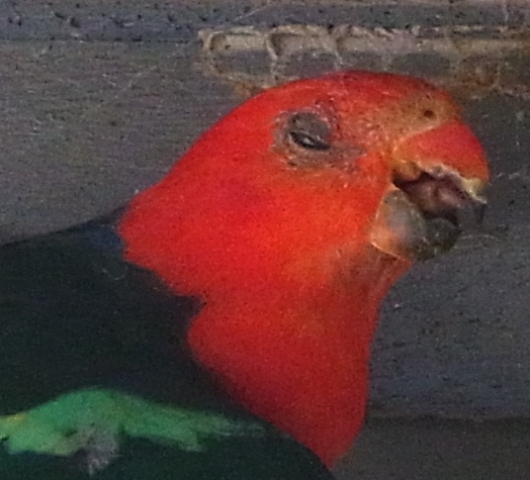
King parrot's pic on a broiling day

Noon. 42°C (over 100 Funnyheight)
Parrots hold their wings out and pant like dogs. This mature gent is sheltering under the balcony's eaves, but getting no joy from the shade.

I've never had much confidence in my skill with a camera, but this photo places me finally, into the ranks of professionals! Need an ID pic?

16 January 2013

God's barroom

Morning in the forest

Today is actually pleasant, but the fires have been discombulating here. Last night I could hardly sleep for the choking stench of stale burn, lightly sprinkled with rain a few days ago. Like God's barroom. Gave me a headache. Today the sky is a smudge, but it's not hot. There are still fires around and many planes flying surveillance, not to mention fire crews roaming the place, putting out as well as lighting fires. But this forest has had its visitation.

14 January 2013

Still life, for a change of pace


Indispensable Classics

Strawberry Caramel from "North Island Product Institute Compass", Japan

Snake Brand Prickly Heat Powder (Classic) from The British Dispensary (L.P.) Co. Ltd., Thailand

The Elements of Typographic Style by Robert Bringhurst

The Hunting Wasps by J.H. Fabre

The Book of Prefaces by Alasdair Gray